
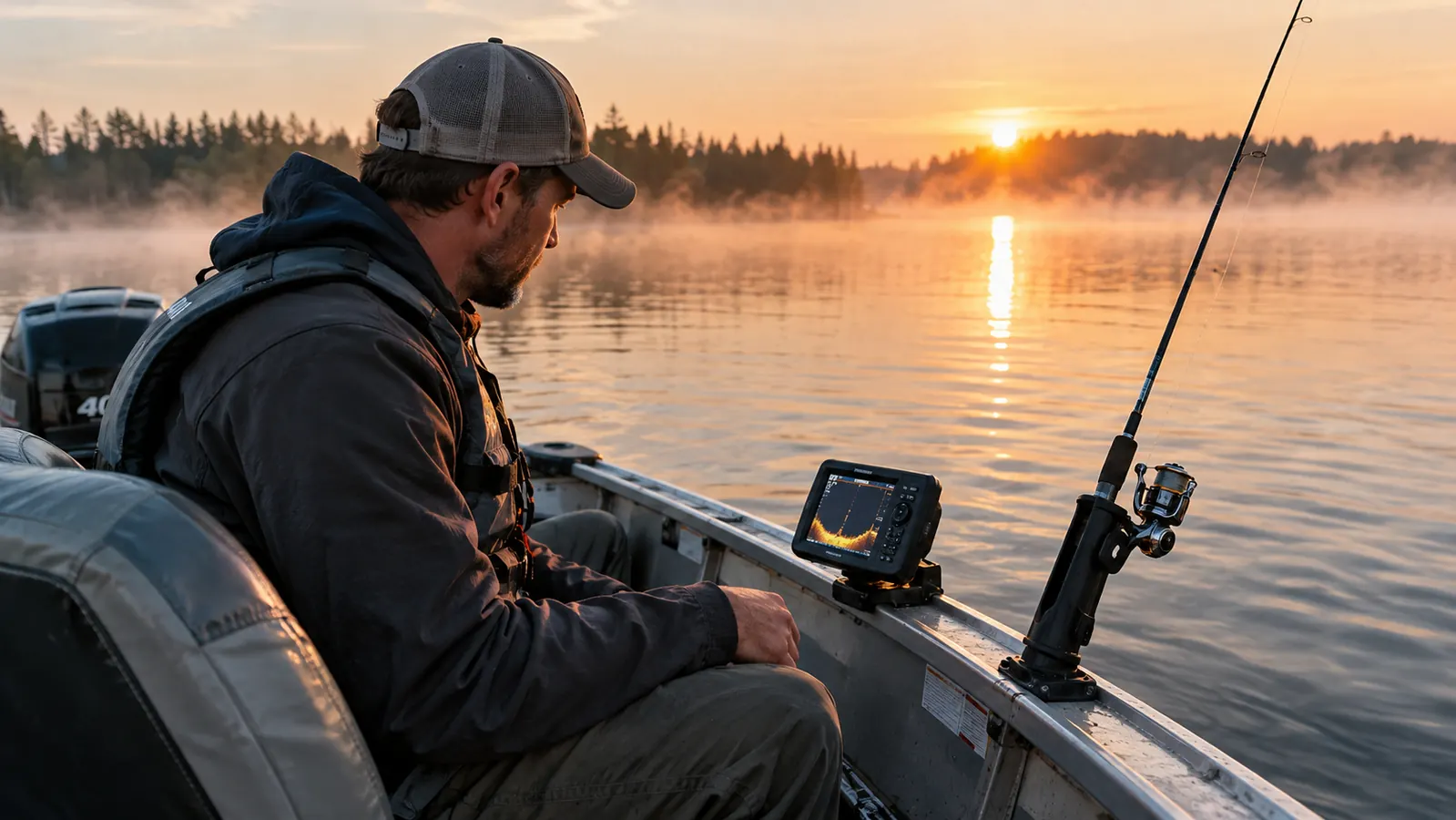
The Garmin Striker 4 has been on the transom of my 16-foot aluminum boat since the ice went out this spring. That is one full open-water season for walleye and bass, plus the first few trips of hard water. I am Curt Lindqvist, retired electrical lineman, and I fish out of Brainerd, Minnesota. This little unit has seen everything from May chop to a January hole cut through eight inches of ice. Here is how it actually held up.
I will start with what you need to know. The Striker 4 is a 3.5-inch GPS fish finder with CHIRP traditional 2D sonar. It does not have side imaging or ClearVu, and if you buy it expecting either, you will be disappointed. What it does, it does well: it shows fish, shows bottom, and saves waypoints so I can find the same weed line three weeks later. That combination is why a lot of guys on these lakes run one. I have had it on every trip since the second week of May, and it has not missed a day.
The Quick Verdict
The Garmin Striker 4 is the right fish finder for a guy who fishes from a small aluminum boat, wants GPS waypoints, and does not need side imaging. The screen is small, but the sonar is honest and the GPS has made me a better walleye fisherman.
Amazon Check Today's Price →The Fish Finder That Earned Its Spot on the Transom
If you fish from a 16-foot boat and want a simple, reliable finder with GPS, this is the one I would buy again. Check today's price on Amazon and see if it fits your boat.
Amazon Check Today's Price on Amazon →How I've Used It
I mounted the Garmin Striker 4 on the transom of my boat on May 12, the first day the launch was open. Not the fancy quick-release bracket, just the standard mount that came in the box, and it has stayed put through a whole season of rough water. The transducer is on the transom, below the waterline, and I have not had to touch it since the day I set it. I ran the cable up through the splashwell and tied it off with a zip tie so it would not catch on anything.
My typical day is simple. I launch alone or with my wife Karen, idle out to a spot I saved as a waypoint, and work the breakline. The Striker 4 shows me the bottom, the weeds, and the fish. When the screen lights up with a nice arch, I drop a jig. That is the whole system, and it has put walleye in the boat all season. On a calm morning in late June, I marked a school on a hump in 14 feet of water and took four fish off that spot before the wind came up.
In the winter, I have used the flasher mode through the ice for perch and walleye. Same unit, same transducer, just drop it down the hole. That one feature has saved me from buying a separate ice flasher. I drilled a hole at the mouth of a weed bay in early January, dropped the transducer, and watched the marks come up off the bottom. By the time I had the jig down, I was already hooking fish.
The Striker 4 runs on a simple 12-volt connection. I wired it into an accessory fuse panel under the rear bench, and it draws next to nothing. I have left it on for a full day of fishing and never once worried about the battery. When the boat sits in the garage over a wet spell, the screen fogs a little inside, but it clears once it warms up. That has happened twice, and neither time did it affect the picture.
In May, before the fish were up on the weed edges, I spent two evenings marking rock piles and stumps with waypoints. That pre-season scouting paid off in June when the fish moved in. I would already know which rock pile had bait and which one was dead. The Striker 4 does not tell you where the fish are on a given day, but it tells you where they have been, and that is the next best thing.
The Screen and Controls
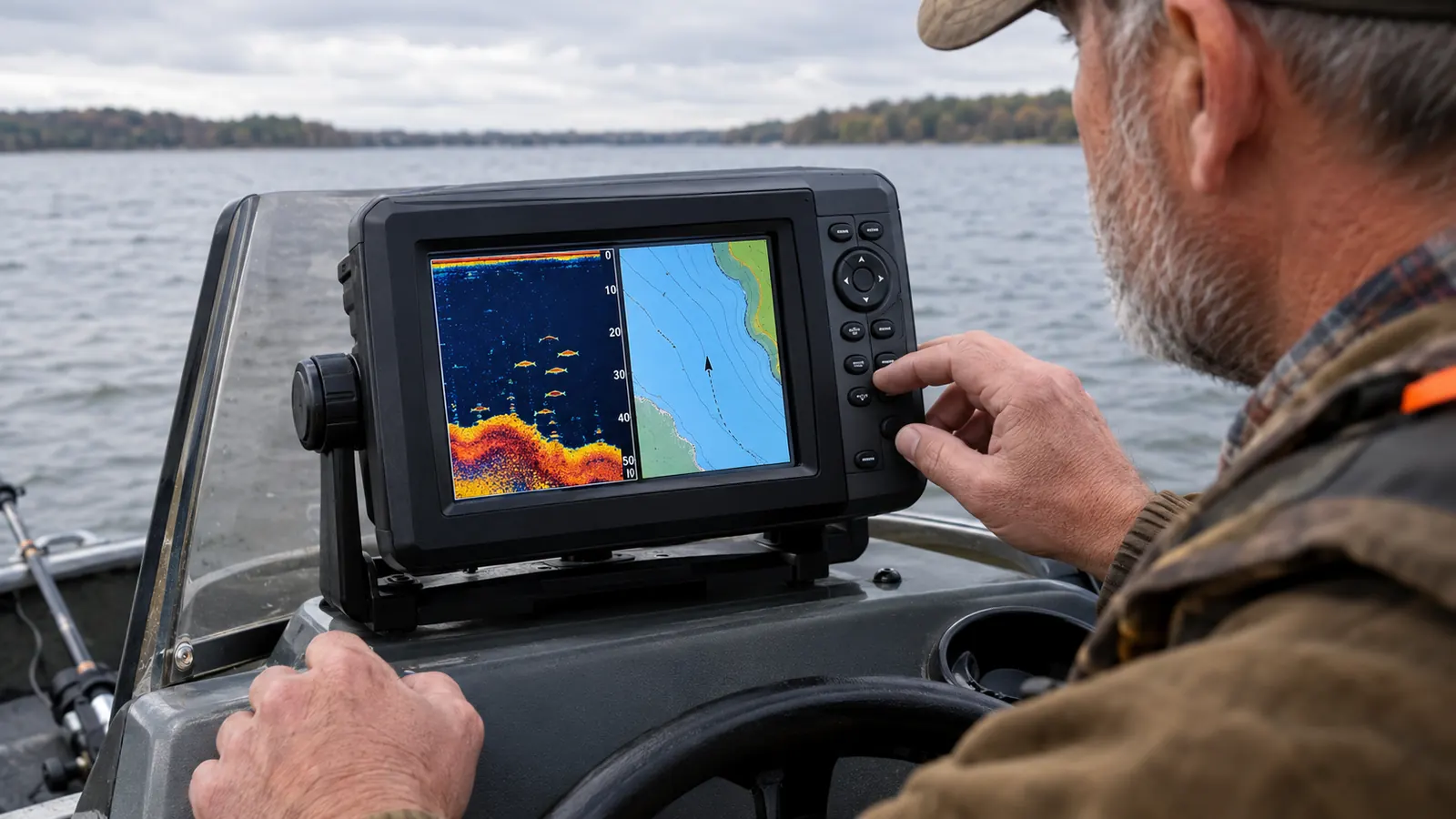
At 3.5 inches, the screen is small, but you have to put that in context. The Garmin Striker 4 goes on a boat where you sit close to it. On my 16-foot aluminum, the unit is mounted on a swivel base right beside the tiller seat. My face is maybe two feet from the screen when I am driving. From that distance, the display is crisp and I can easily read the depth, the bottom contour, and the fish arches. It is not a screen you will watch from the bow, and I would not try.
Where it struggles is bright sun and off-angle. At noon on a flat-calm August day, I have to shade the screen with my hand to see it clearly. It is readable, but I have to be straight on. If I am standing at the back deck, turned sideways, I cannot make out the numbers. That does not bother me because I look at it only when I am casting. But if you expect to glance across the boat, lower your expectations.
The controls are the part that surprised me. There is a round directional pad and a power button, and that is basically it. I set it up in ten minutes without reading the manual cover to cover, and I have not touched the settings since. The gain setting is the one I adjust most, and even that I only do when I change lakes. On a lake with a muddy bottom I turn the gain down a notch; on a clear lake I leave it alone. It is simple, and simple is good.
GPS Waypoints: The Real Reason I Bought It
Before the Garmin Striker 4, I found spots by lining up a cabin, a dead tree, and a point. That works until the water comes up or the light changes. Now I mark the waypoint and I can find the same weed line three weeks later, even in the dark. I have saved about two dozen waypoints this season. The humps, the breaklines, the rock piles, and the spot where the big walleye bit in June. When I want to go back, I just follow the arrow on the screen.
Here is a concrete example. In late July, Karen and I found a sunken island in the middle of the lake. The top of that island was at 11 feet, and the walleyes were holding along the drop into 20. I hit the waypoint button, gave it a name, and we came back three weekends in a row. Every time the arrow pointed us straight to it, no searching. That is the difference between fishing and looking for fish.
The GPS does not have a mapping card, so there is no lake map on the screen. That is a limitation I accepted when I bought it. You are not getting a chartplotter, you are getting a finder that remembers where you have been. For a guy who fishes the same half dozen lakes, that is plenty. If you are the kind of angler who hops around to a new lake every weekend, you would want to look at something with a map.
The waypoint names are nine characters of all caps, which is enough for me. I label them like WEEDLINE 2 and SUNKEN ISL. If I could type more, I might, but I have not once been confused about which spot is which. The arrow screen is dead simple: a big arrow and a distance readout. It points you to the waypoint and tells you how many feet away you are. That is all I need.
CHIRP Sonar and the Ice Mode
The Garmin's CHIRP traditional sonar is what you are actually paying for. It sends a sweep of frequencies instead of a single ping, and the result is cleaner returns and better separation of fish from bottom. I can see a walleye tucked right against a rock pile that I would never have picked out from the surface. On a flat late-September morning, I pushed the boat out over a gravel bar in 9 feet of water. The screen showed a tight band of bait, then a pair of arches hanging right below it. I dropped a jig, and one of those arches came up with a 22-inch walleye.
I will be honest about the limitation, because it is the one that surprises people. There is no side imaging and no ClearVu. You cannot see fish off to the sides of the boat, and you cannot get that crisp photo-like image of structure. The cone angle is about 20 degrees, so when you are in 20 feet of water, you are looking at a circle roughly 7 feet across. That is a small window. But it is the window I fish in with a jig or a crankbait, so I am not missing much.
What you do get is a flasher mode, and it is the feature that surprised me the most. Through the ice, the same transducer drops down the hole and the screen becomes a flasher. I took it out for perch and walleye at first ice, and the flasher mode did the job of a dedicated ice flasher. At first ice I set up over a basin in 24 feet of water. The flasher lit up at 17, 18, and 21 feet, and I pulled a limit of perch out of that hole. That alone is worth a good chunk of the price.
The learning curve is short, but there is one. The first time I used the flasher mode, I had to watch it for ten minutes to believe what I was seeing. The colored marks move up and down with the wave action, and you need to ignore the motion and look for the solid fish marks. Once you get that, it is second nature.
What You Give Up
Here is the thing I tell guys when they ask me if this finder will do everything. It will not. There is no way to put lake maps on it, the screen is not big enough to see from the back deck, and the included mount is basic. You can upgrade the mount, but the screen stays small. If you fish from a big center console or a bass boat where the transducer is fifteen feet away from where you sit, this is not the unit you want.
The Striker 4 is honest about what it is. It is a 3.5-inch sonar and GPS unit that costs less than a lot of rods. It does not pretend to be a 9-inch chartplotter. If you buy it knowing that, you will be happy with it. If you buy it hoping it will do what a Helix or a Solix does, you will be disappointed. That is not a fault of the unit; that is a fault of the expectation.
At the end of the season, the unit still looks good. The screen has a few micro scratches from being laid on the ice, but nothing that affects visibility. The buttons all have a solid click. The mount has not loosened. I will see how it does next spring, but so far there are no signs of wear.
What I Liked
- Reliable CHIRP sonar with clean returns and good fish separation
- GPS waypoints let me find the same spots all season
- Flasher mode works through the ice, so I did not need a separate ice flasher
- Simple menu, set up in ten minutes and never touched it again
- Transducer and mount held up through a full season of rough water
Where It Falls Short
- 3.5-inch screen is small and needs to be viewed straight on
- No side imaging and no ClearVu
- No lake maps, just a blank screen with waypoints
I have saved about two dozen waypoints this season, and I can find the same weed line three weeks later. That is what sold me on this unit.
Who This Is For
The Garmin Striker 4 is for the guy who fishes from a small aluminum boat, wants a simple reliable finder, and wants GPS waypoints without paying for a chartplotter. It is for the guy who fishes the same lakes year after year and wants to mark the spots instead of memorizing them. It is also for the ice fisherman who does not want to buy a separate flasher. The same unit does open water and hard water, which means one less piece of gear in the truck. That is a real advantage if you fish year round like I do.
If you are that guy, the Striker 4 will get you on fish faster. You will spend less time idling around looking for structure and more time with a bait in the water. I do not need a big color screen to tell me a fish is down there. I need a tool that finds bottom and holds a waypoint. This one does both.
Who Should Skip It
If you fish from a big boat and need to see what is happening off to the sides, skip the Striker 4 and get a unit with side imaging. The 3.5-inch screen will also frustrate you if you want to watch it from the bow or share it with a partner in a big rig. And if you want a lake map on the screen, this is not it. The Striker 4 remembers where you have been, but it does not show you the contour of a lake you have never fished. For my home lakes, that is fine. For a guy who travels to new water every weekend, it would not be enough.
If you are that guy, save up a little more and look at a unit with a bigger screen and mapping. You will be happier in the long run. But if you are honest about the way you fish, the Striker 4 will do everything you need and then some.
One Last Thing
After a full season and the first ice, I would buy the Striker 4 again. Check today's price on Amazon and see if it fits your boat.
Amazon Check Today's Price on Amazon →