
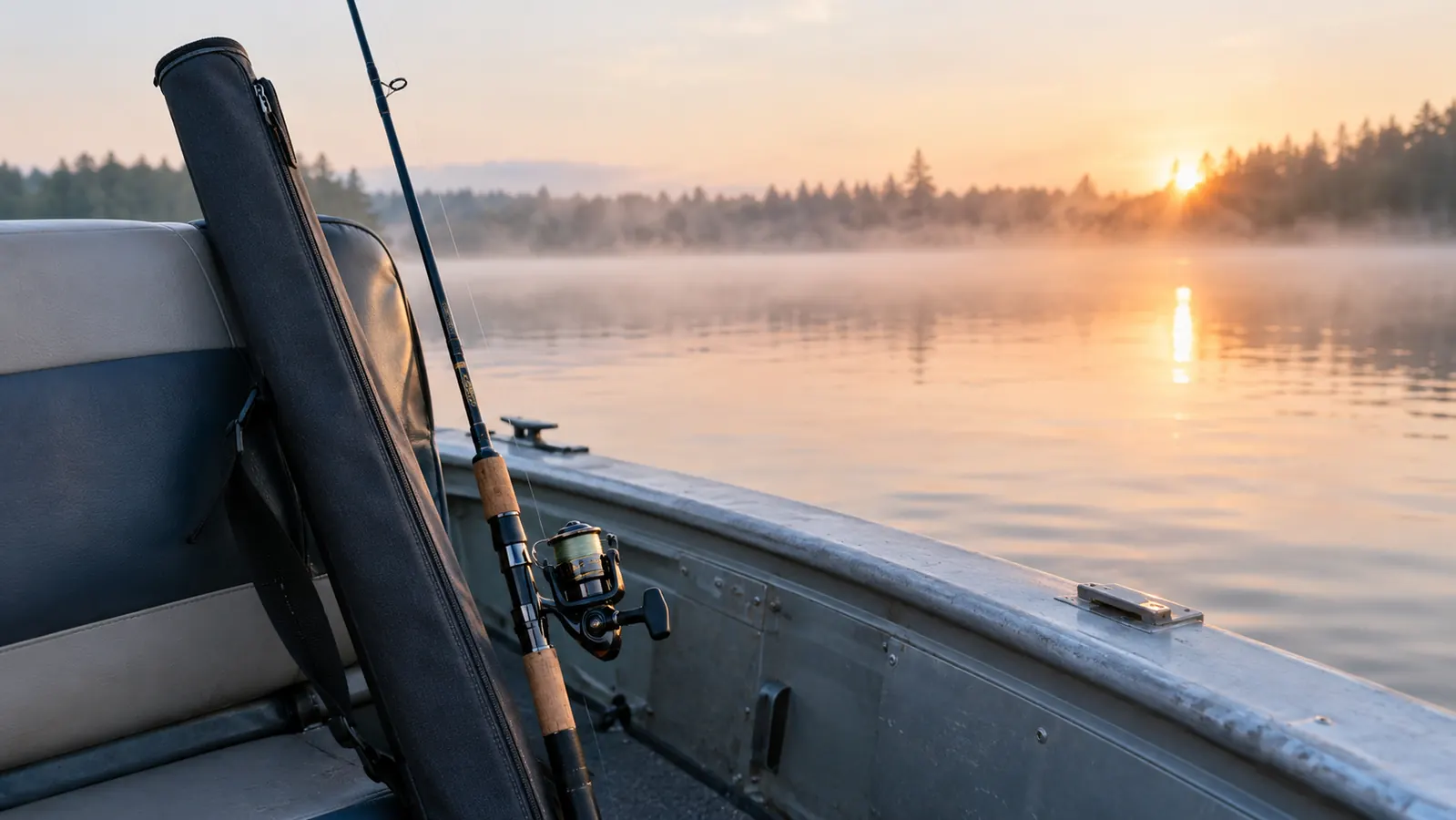
The OKUMA Voyager travel kit is the rod that lives behind the seat of my 2013 F-150. That is the whole point of it, and it is also the thing the product page does not quite say out loud. You are not buying the best feeling spinning rod you will ever own. You are buying the rod that is actually there when the evening is right and the lake is ten minutes away. After a full open-water season with this kit, from May through October, I think that trade is worth making. I also think you should know what it costs you.
I am Curt. I fish walleye and bass on area lakes out of a 16-foot aluminum boat, and I spent years being the guy who left the tackle in the basement and then drove past the lake anyway because loading the gear felt like a project. That is the problem this kit is trying to solve, and it solves it honestly. What follows is the honest version: what worked, what did not, and what I would tell a neighbor before he bought one.
The Quick Verdict
A travel spinning kit that earns the spot behind the truck seat. The drag is smooth enough for walleye and bass and light for a big pike, and the convenience is real. You give up a little feel and a little casting distance to get it, and for evening stops at the lake I make that trade every time.
Amazon Check Today's Price →The rod that is actually there when the lake is right
If you are tired of driving past the lake because the gear is in the basement, the OKUMA Voyager kit is the fix. It has ridden behind my seat all season, and it has made me fish more, not less.
Amazon Check Today's Price on Amazon →How I've Used It
I spooled the reel with 8 lb monofilament on the first Saturday in May, when the water on the area lakes was still in the low 50s and the walleyes were holding deep and slow. The kit went behind the seat of the truck the same day, and that is where it stayed until the end of October. I did not plan it that way. It just turned out that the rod was easier to bring along than to leave behind, and that changed how often I fished.
Most of my trips were evening stops. I would be coming back from town or from checking on the boat, the lake would be flat and the light would be right, and I would pull in. Not full trips. Forty-five minutes, maybe an hour. Karen came along on a good number of those evenings, and she used this rod as much as I did. That is the honest test of a travel kit: it does not have to be the best rod you own, it has to be the one that gets used.
The season went like this. Mid-June, a Tuesday evening, water at 68 degrees, I caught four bass off a rocky point on soft plastics. Late July, Karen landed a walleye that went maybe 24 inches on a jig and minnow, and the drag never hiccuped. Late September, the evening the wind finally laid down after three days of blow, I put the boat in and caught three walleyes in 45 minutes from the same drop-off. That is the pattern the whole season held. I fished more this summer than I have in years, and the reason was not ambition. It was that the rod was already in the truck. The first trip of the year was not even a planned trip. I stopped at a public access on the way back from town, and the rod was right there behind the seat. That first evening I caught one small walleye, and I was sold on the idea of the kit before I had even put it back in the case.
What Nobody Tells You About the Case
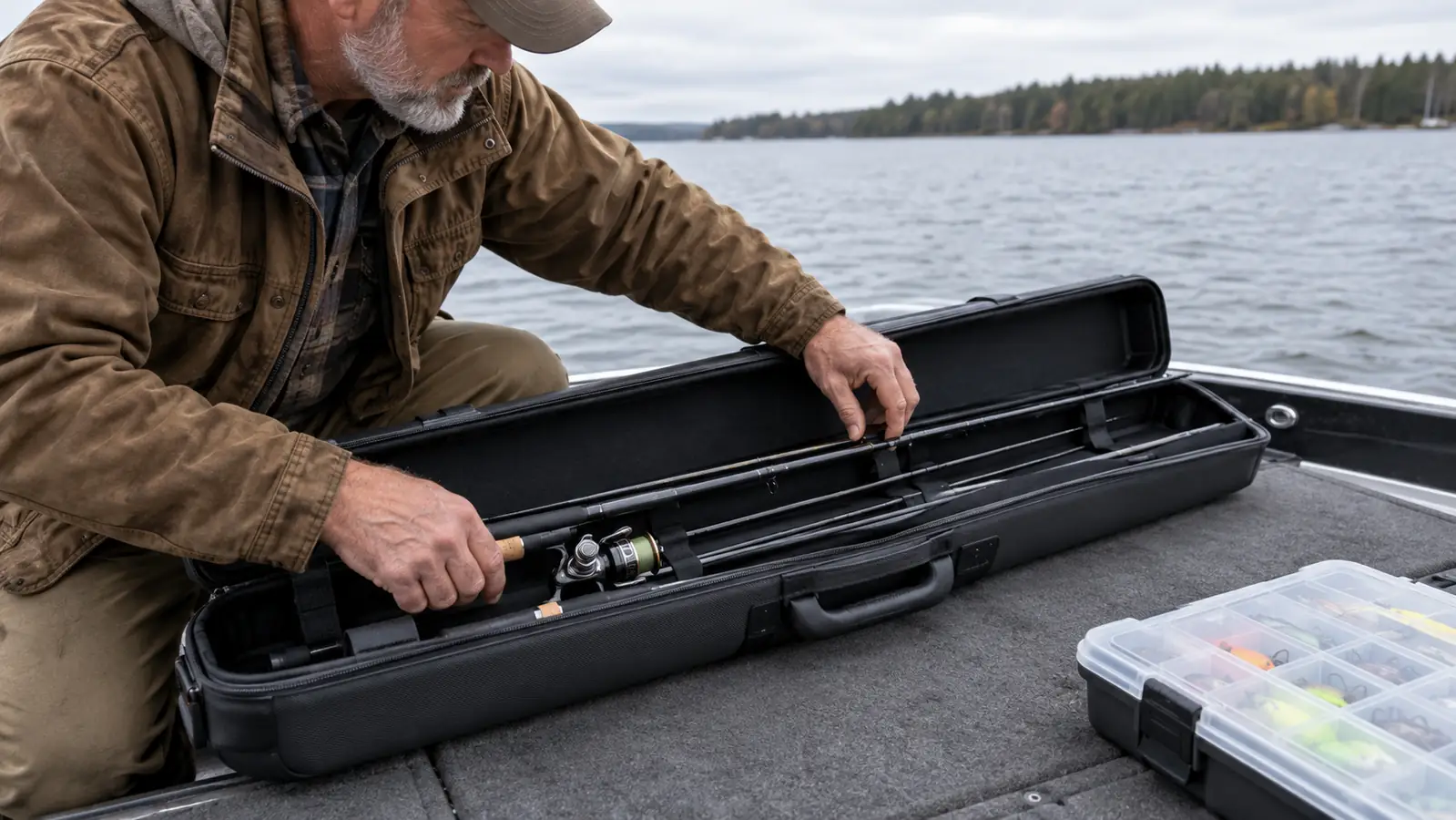
Here is what nobody tells you about a travel rod. The case is the feature. The rod sections and the reel are the parts you can judge from the photos, but the case is the reason you will actually keep this thing in the truck and not on a shelf. It holds everything together, it rides behind the seat without rattling, and it keeps the guides from getting banged up when you toss it in and out of the truck. I have had it in and out of the F-150 well over a hundred times this season.
The other thing nobody tells you: the case takes up more room than you expect. It is not a skinny tube you can wedge behind the seat. It is a real package, and it sits on the floor behind the driver's seat in my truck, or across the back seat if Karen has the cooler back there. It has not been in the way once. But if you drive a small car and you were picturing something that slides under the seat, adjust the picture.
Assembly is the part people worry about, and it turns out to be a non-issue. You line up the sections, you seat them firmly, and you go. Early in the season I was fussy, checking the alignment twice. By August I could have it together and rigged in the time it took Karen to get her life jacket on. The guides line up fine if you seat the sections fully. If the line starts catching on a guide mid-cast, the section is not seated. That was the one thing I had to relearn, and it happened exactly once before I figured it out. The other thing I learned: seat the sections dry. A wet ferrule seated under pressure will seize up, and then you are the guy on the shore wrestling with his own rod. I found that out on a rainy evening in July, and it added ten minutes to a 45-minute trip.
The Rod: What You Give Up for the Joints
Now the part I would tell you straight. A multi-piece rod is a collection of compromises, and the OKUMA Voyager makes them in the right places for a travel kit, but it does make them. The joints are where vibration stops. On a one-piece rod, a light bite telegraphs straight down the blank to your hand. On this rod, some of that signal stops at each joint. You still feel the bite. You feel it a beat later and a little softer.
Casting distance is the other compromise, and it is the one that bit me. This is not a rod for bombing a cast across a wind-chopped lake. You can get a jig out there far enough to work the drop-off, and you can put a soft plastic up against the bank, but if your fishing depends on 60-yard casts, this is not the rod for that job. I learned that on a windy evening in September when the walleyes were holding a long cast off the point. I managed. I worked for it, but I managed. For anyone who likes numbers: I could reach a drop-off at about 35 to 40 yards with a quarter-ounce jig and the 8 lb mono. That covered most of my fishing. It did not cover the far edge of the weed line on the big lake.
What the rod does well is the jobs a travel rod should do. It has enough backbone to set a hook on a decent bass, it loads up fine with the 8 lb mono when you are casting a jig head, and it forgives the sloppy cast you make from a moving boat. For walleye and bass on area lakes, which is what I bought it for, it is plenty of rod. The honest way to say it: it does not feel like a travel rod when a fish is on. It just feels like a rod.
The Reel and the Drag
The drag is the part that surprised me, and it is the part of the kit that is genuinely better than the kit has any right to be. I set it light for walleye, and it paid out line smoothly when a fish ran. No stutter, no grabby starts. That is the difference between a drag that lands fish and a drag that loses them, and this one lands them.
The pike I mentioned. It hit a jig in about 12 feet of water one warm evening in July, and it ran. I had the drag set for walleye, which is to say light, and the reel let line out in a steady way that kept the hook in. The pike was not a monster. Call it mid-30s. But it was a lot more fish than I expected this rig to handle, and the drag handled it. The reel felt light for that fish. That is the honest review of it: for walleye and bass it is smooth, and for a big pike it is the weak link, but it is a weak link that still works. I did get that pike to the boat in the end, but it was closer than I liked. I got it to the boat after one last run, and I was glad the drag let it go when it wanted to. The point was that the drag had done its job through the whole fight, and that told me more about the reel than any product description could.
The reel balances fine on the rod, which is more than you can say for a lot of combos where the reel feels bolted on as an afterthought. The bail flips over cleanly, the line lays even, and after a full season of bouncing around behind the truck seat it still turns smooth. I rinsed it after trips when it got splashed, and I did nothing else to it all season. That is the maintenance level it asks for.
Where It Falls Short
Now the honest part, the stuff the product page leaves out. First, the rod is not sensitive enough for the lightest finesse work. When I was jigging for walleyes in that slow May bite, I could feel the difference between this rod and a good one-piece jig rod. It is not a dealbreaker. It is the trade you are making, and you should make it with your eyes open. I switched to my one-piece jig rod for that May bite and caught more fish. That is the honest comparison. The Voyager sat in the truck for two weeks, and when the bite slowed and the fish came shallow, it went back to work.
Second, the wind. This is a light kit, and in a stiff breeze it gets pushed around. A 15 mph wind across the lake means you are fighting the rod on the cast and you are not getting the distance you want. I fished evenings mostly, when the wind usually lays down, so it mattered less to me. If your only chance to fish is the windy middle of the day, think hard about it. The worst evening was early October, when a southwest wind had been building all day and the lake was running whitecaps by six. I put the rod together anyway, made about ten casts, and put it back. Some evenings the wind wins, and a light travel kit loses first.
Third, the small stuff. The kit does not come with much in the way of instructions. The case does not have a pocket for a spare spool or a pair of pliers. And if you put the rod away wet and leave it in the case for a week, the sections get stubborn to separate. None of that is a reason to skip it. All of it is stuff you find out after you own it, which is exactly what this review is for. The reel handle does not fold, which is a small thing until you are packing the kit back into the case and the handle is in the way. You find the right angle for it after a few tries.
What I Liked
- The whole kit rides behind the truck seat, so you actually fish more
- The drag is smooth for walleye and bass and still handled a pike that was more fish than the rig was built for
- Breaks down and assembles fast once you learn to seat the sections fully
- Reel and rod balance well together, not like a bolted-on kit reel
- Survived a full season of bouncing around in the truck with nothing but a rinse
Where It Falls Short
- The joints soften the feel of light bites compared with a one-piece rod
- Not a long-casting rig in wind, you give up distance when you need it
- The case takes more room than you expect and has no pocket for a spare spool
- Too soft for the lightest finesse jigging, you can feel the difference
I fished more this summer than I have in years, and the reason was not ambition. It was that the rod was already in the truck.
Who This Is For
This kit is for the guy who drives past the lake because the gear is a hassle. It is for the angler who wants an evening on the water without loading the boat and without running home for the rod that is in the basement. It is for the person who flies somewhere and wants to fish when they get there, or for the person who keeps a rod in the truck for the same reason I do. If that is you, the OKUMA Voyager is the right tool. I have talked to two neighbors about this kit since October, and I told them both the same thing: buy it for the case, not the rod, and you will not be disappointed.
It is also for a specific kind of fishing. Walleye and bass on lakes, jigs and soft plastics, 8 lb mono, 45-minute stops. For that work the kit is genuinely good, and I would buy it again. Karen would tell you the same, and she is harder to please on gear than I am.
Who Should Skip It
If your fishing is long casts in open water, this is not your rod. If you fish where a light bite at 40 feet is the difference between a good day and a blank, buy the one-piece rod and keep it assembled. If you want one rod that does everything, the Voyager is not that either. It is a travel kit with travel kit compromises, and pretending otherwise is how people end up disappointed.
And if you are the kind of angler who wants every rod to be the best in its class, here is the honest version. The kit makes sense because of the case and the convenience, not because the blank is the best you will ever hold. Buy it for what it is and you will be happy with it. Buy it expecting a dedicated one-piece feel and you will not.
One season in, I would buy it again
The OKUMA Voyager kit has earned the spot behind my seat. If that sounds like the fix for how you fish, check today's price on Amazon and read the current owner reviews before you decide.
Amazon Check Today's Price on Amazon →