
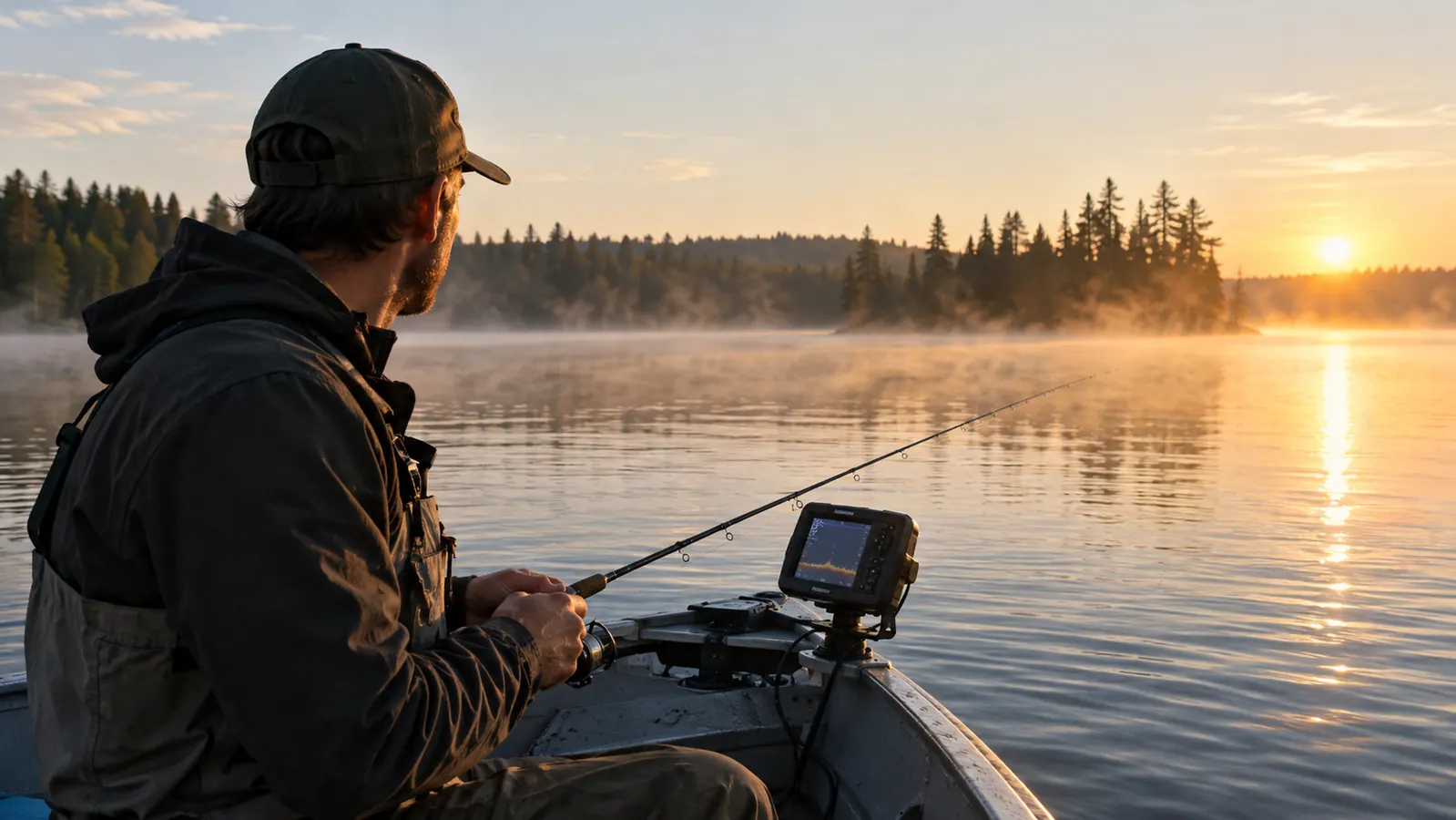
I will tell you straight up what the Garmin Striker 4 is not. It is not a side-imaging unit. It is not a ClearVu unit. It is not a big screen you can read from across the boat. If you came here hoping somebody would talk you into a high-end fish finder, you are reading the wrong review. What the Striker 4 is, is an honest little sonar and GPS unit that does the basic jobs well, costs a reasonable amount, and has limits you should know about before you buy. I ran one on the transom of my 16-foot aluminum boat all open-water season and then took it onto the ice, and I can tell you exactly where it earns its keep and where it does not.
I am Curt Lindqvist, retired electrical lineman, and I fish walleye and bass on the lakes around Brainerd, Minnesota. I bought the Garmin Striker 4 this spring, mounted it myself, and used it through the whole open-water season and the first ice. This is the honest version of that experience. The short version: it is a good tool for a small boat angler who wants to mark fish, see bottom structure, and save a few waypoints. It is not the tool for someone who wants a big color screen with imaging. Knowing that difference before you order is worth more than any spec sheet.
The Quick Verdict
The Garmin Striker 4 is the right fish finder for a 16-foot aluminum boat: simple CHIRP sonar, a usable GPS, and a screen that is small but readable. It will not show you side imaging or ClearVu, and the screen is genuinely small. Buy it for what it does, not for what it does not.
Amazon Check Today's Price →A small-boat fish finder that does the basics right
The Garmin Striker 4 gives you CHIRP sonar, a flasher mode for ice, and GPS waypoints in a package that fits a 16-foot aluminum boat. See today's price on Amazon and read the current buyer reviews.
Amazon Check Today's Price on Amazon →How I've Used It
I mounted the Garmin Striker 4 on the transom of my boat in early May, right after ice-out. The unit itself is small, with a 3.5 inch screen, and the transducer mounts on the back of the boat with the included hardware. I ran the cable up to the unit and secured it with a couple of zip ties. Total install time was maybe 20 minutes, and I did not have to drill any holes I was not willing to drill. The mount is a simple ball mount, and it holds the unit where I can see it from the tiller seat.
From May through October I used it on every trip, probably 30 or 40 outings on a half dozen lakes. Then in December I took it off the boat, put it on a bucket through the ice, and used the flasher mode for perch and walleye. That is the full arc of a season, and it is the only fair way to review a fish finder. A unit can look great in the driveway and be useless on the water, or the reverse.
The Garmin unit does not have a built-in map of the lake bottom. What it has is a GPS that lets you save waypoints, and a sonar that shows you the bottom as you drive over it. That combination is more useful than it sounds. I marked the breaklines and humps I found, and by August I had a mental map of the lakes I fish that I never had before. The GPS is not a chartplotter. It is a breadcrumb trail and a waypoint saver. For the way I fish, that is enough.
What the Screen Is Really Like
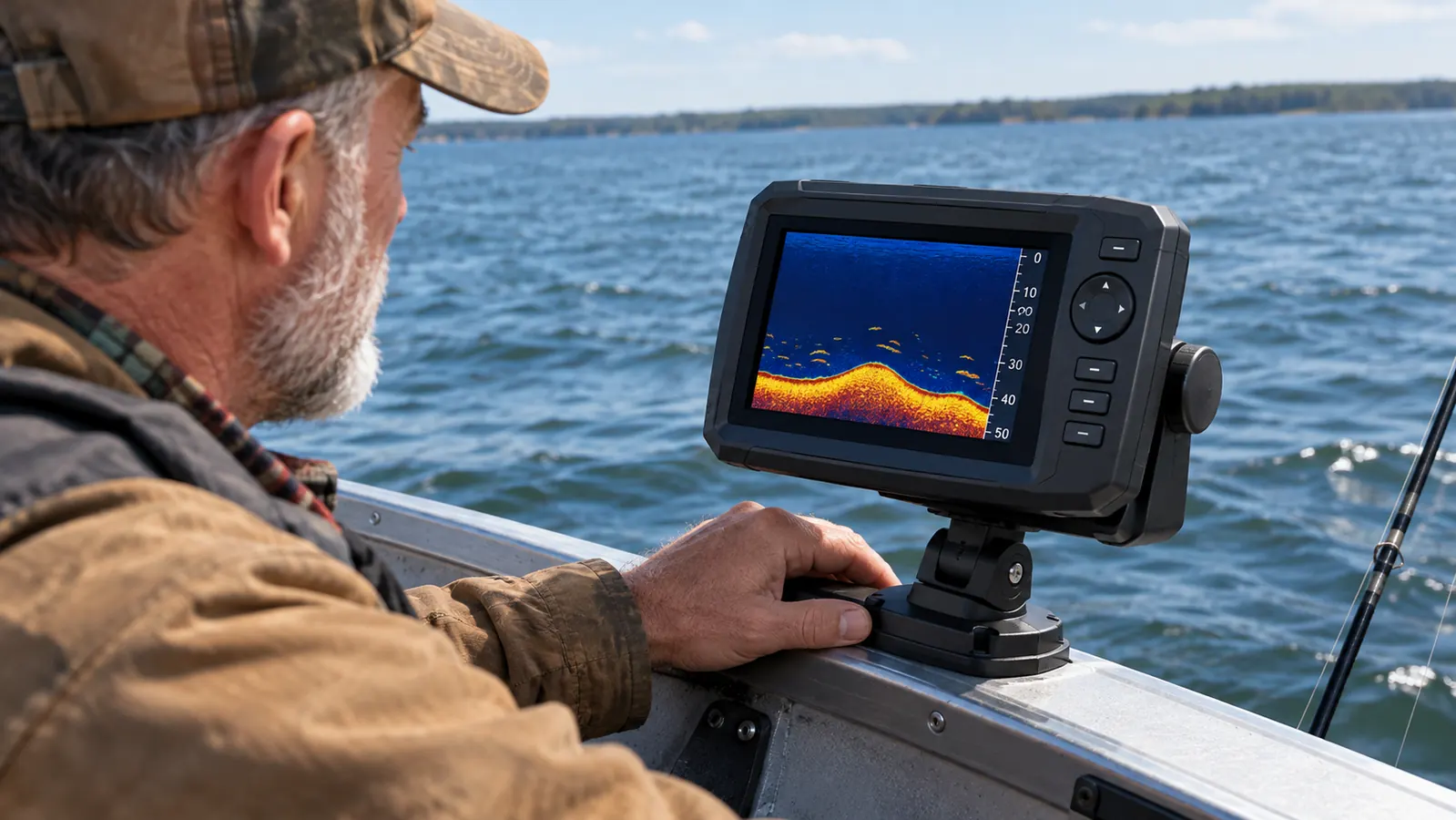
The 3.5 inch screen is the first thing people ask about, and it is the honest weak point of the Garmin Striker 4. It is readable in direct sun if you look at it straight on. The moment you view it from an angle, the contrast drops and you are squinting. On my boat the unit sits at the tiller, so I am looking at it head-on most of the time. That works. If you plan to mount it at the bow and read it from the back of the boat, you will be disappointed.
The screen is also small enough that you will not see a lot of history at once. You see the sonar return as it happens, and a little bit of the recent past. That is fine for marking fish and watching bottom. It is not fine for studying a big picture of the lake. If you are used to a 7 inch screen, this will feel like looking through a keyhole for the first few trips. You get used to it, but you should know it going in.
One thing that surprised me is how much the screen angle matters. The included mount lets you tilt the unit, and you will spend the first trip adjusting it. Find the angle that kills the glare and leave it there. I set mine once in May and did not touch it again all season. That is the kind of small detail that makes a unit feel right or wrong.
CHIRP Sonar: What It Shows and What It Misses
The Garmin Striker 4 uses CHIRP traditional 2D sonar. That means it sends a sweep of frequencies and reads the return, which gives you a cleaner picture of the bottom and better target separation than the old single-frequency units. For walleye fishing, that matters. I can see a fish holding tight to a breakline, and I can see the difference between a rock pile and a mud flat. The bottom lock is solid, and the unit does a good job of showing structure.
What it does not have is side imaging or ClearVu. You will not see fish off to the sides of the boat. You will not get a photo-like image of the bottom. You get a cone of sonar straight down, and that is it. For the way I fish, straight down is what I need. I drift over a breakline, watch the bottom come up, and mark the spot. I do not need to see 100 feet to either side. But if you fish big water and want to cover water fast, the lack of imaging is a real limit.
The target separation is good for the price. I can see a walleye holding a foot off the bottom, and I can see a school of perch as a cloud. The unit does not magically tell you what species you are looking at. It shows you a return, and you learn to read it. That learning curve is real. My first few trips I marked everything and caught nothing. By fall I was reading the screen well enough to know when to drop a jig and when to move.
The Garmin Striker 4 will not show you side imaging or a photo of the bottom. What it will do is show you a clean, honest picture of what is under the boat, and that is what most walleye fishing actually needs.
The Flasher Mode and Ice Fishing
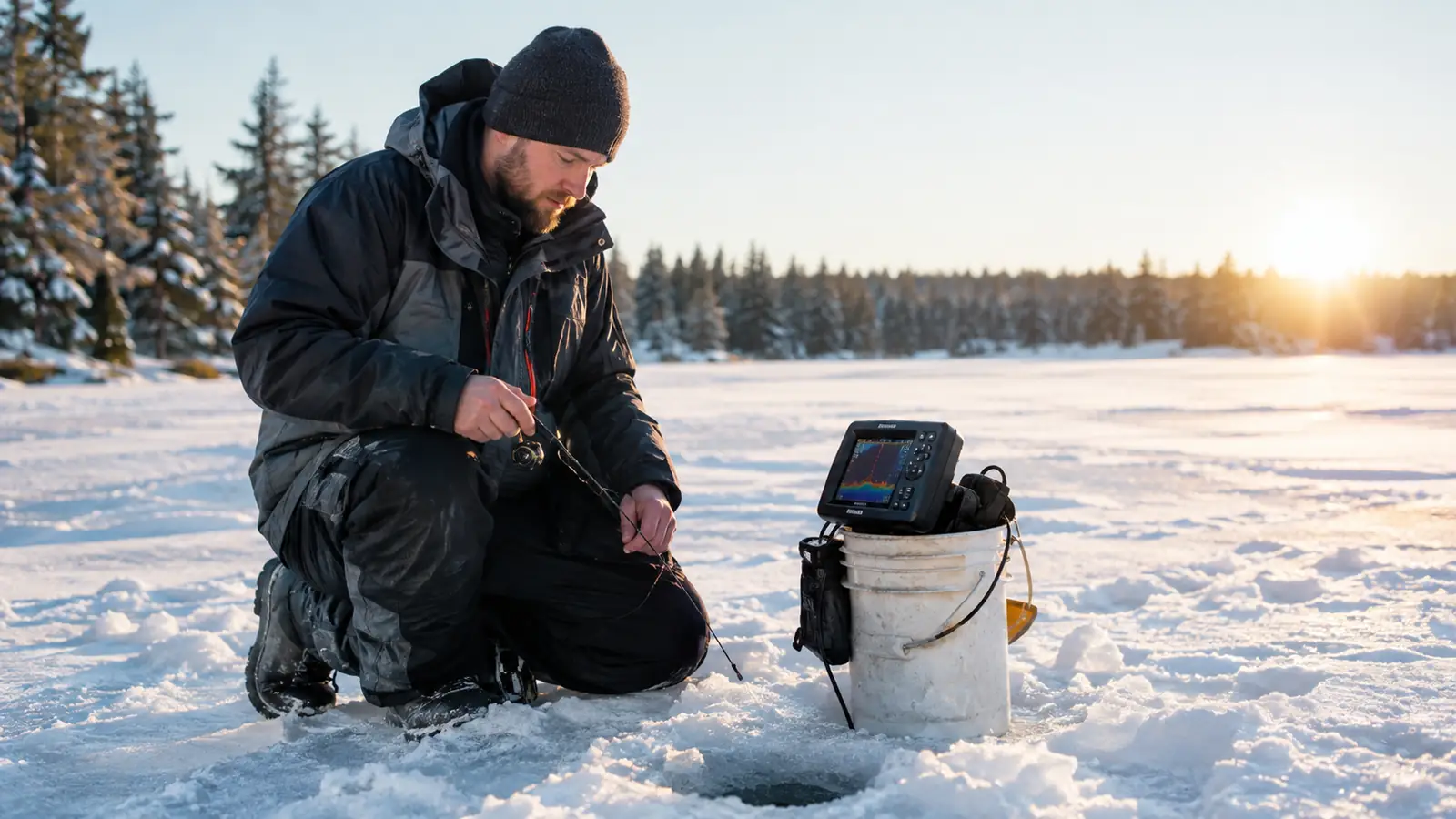
Here is the part of the Garmin Striker 4 that nobody talks about in the product listing, and it is the reason I kept the unit instead of trading it in. It has a flasher mode. You switch the display from the traditional sonar view to a flasher, and suddenly you have an ice fishing flasher that shows your jig and the fish in real time. I used it through the first ice in December, sitting on a bucket with the transducer hanging in the hole, and it worked.
The flasher mode is not as refined as a dedicated ice flasher. The screen is small, and you are reading a thin band of color around the edge instead of a big circular display. But it shows you your jig, it shows you fish coming in, and it shows you when they leave. For a guy who ice fishes maybe 15 times a winter, that is plenty. I do not need a second dedicated flasher when the Garmin unit already does the job.
The battery situation is worth knowing. On the boat, the Garmin Striker 4 runs off the boat battery with the included power cable. On the ice, you need a separate 12-volt battery. I used a small sealed lead-acid battery in a soft case, and it ran the unit for a full day of fishing without issue. The unit does not come with a battery, so factor that into your plan if you want to use it on the ice.
GPS and Waypoints: Simple but Useful
The GPS on the Garmin Striker 4 is not a chartplotter. It does not have a map of the lake. What it does have is the ability to save waypoints and mark your position. That sounds basic, and it is, but it changed how I fish. I mark the breakline where I caught fish in May, and in August I can go back to the exact spot. I mark the hump that held bass in June, and I can find it again in the fall. Before this unit, I was lining up on shore landmarks and hoping.
The waypoint system is simple. You press a button, the unit saves your current position, and you can name it or leave it as a numbered point. The screen shows a list of your saved waypoints, and you can navigate to any of them with a basic arrow display. It is not turn-by-turn navigation. It is a compass arrow that points you toward the waypoint. For finding a breakline in the dark, that is all I need.
The GPS also gives you a track of where you have been. That is more useful than I expected. When I am drifting a shoreline, I can see the track of my drift and adjust to cover the water I missed. When I find a school of perch, I can see the exact path that put me over them. The track log is a simple line on the screen, but it is a line that teaches you about the lake.
Mounting and Installation: What Nobody Tells You
The included transom mount works, but it is not the most confidence-inspiring piece of hardware I have ever handled. The bracket is plastic, and the ball mount holds the unit with friction. It stays where you put it, but you will want to check the tightness after a rough ride. I added a small tether from the unit to the boat, because the thought of watching my fish finder bounce into the lake is not a pleasant one.
The transducer cable is long enough for a 16-foot boat, and the included hardware is adequate. You will need a couple of zip ties and maybe a small drill bit. The transducer itself is a standard transom mount, and it sits in the water flow without too much drag. I did not notice any performance loss on the boat, and I did not have to adjust it after the first trip.
One honest complaint: the power cable is not the longest, and the connector is a little fiddly. If you are mounting the unit at the bow of a bigger boat, you may need an extension. On my 16-footer, the cable reached fine from the transom to the tiller. The unit is only ever on the boat, never on a truck dash, so I did not need a portable power solution beyond the ice battery.
What the Garmin Striker 4 Cannot Do
Let me be direct about the limits, because the product listing will not tell you these. The Garmin Striker 4 has no side imaging, no ClearVu, no built-in lake maps, and no Wi-Fi. You cannot connect it to your phone to see your sonar on a bigger screen. You cannot download maps to it. You get the sonar, the GPS, the flasher mode, and a small screen. That is the whole package.
The screen is the limit you will feel most. At 3.5 inches, it is small. You will not see a lot of detail at a glance, and you will not be showing it to your fishing partner from across the boat. If you have aging eyes, like I do, you will spend a few trips leaning in to read it. It is readable, but it is not comfortable for long sessions of staring at the screen.
The Garmin unit also does not have a built-in battery. On the boat that is fine, because you are wired to the boat battery. On the ice, you need to bring your own 12-volt battery. That is an extra cost and an extra piece of gear to remember. It is not a dealbreaker, but it is a detail that surprises people who buy the unit expecting it to be self-contained.
What I Liked
- CHIRP sonar gives a clean, honest picture of bottom structure and fish
- Flasher mode turns it into a usable ice fishing unit
- GPS waypoints and track log are simple and reliable
- Small, light, and easy to mount on a 16-foot aluminum boat
- Readable in direct sun when viewed straight on
Where It Falls Short
- 3.5 inch screen is genuinely small and washes out at an angle
- No side imaging, no ClearVu, no built-in lake maps
- No Wi-Fi, so you cannot view sonar on your phone
- No included battery for ice fishing use
- Plastic mount needs a check after rough rides
Who This Is For
The Garmin Striker 4 is for the angler with a small boat who wants to mark fish, see bottom structure, and save waypoints without spending a lot. It is for the guy who fishes walleye and bass on lakes he already knows, and who wants a tool that makes him a better angler, not a bigger screen. It is for the ice angler who wants one unit that does double duty on the boat and on the ice. If that sounds like you, this is a good buy.
It is also for the angler who is honest about what they need. I do not need side imaging because I fish a 16-foot boat on lakes I have fished for 30 years. I need to see the bottom, mark the breakline, and find the spot again. The Garmin Striker 4 does those three things well. If you fish the same way, you will be happy with it.
Who Should Skip It
Skip the Garmin Striker 4 if you fish big water and want to cover ground fast. Without side imaging, you are limited to what is directly under the boat, and on a big lake that is a slow way to find fish. Skip it if you want a screen you can read from anywhere in the boat, because the 3.5 inch display will not give you that. Skip it if you want to see your sonar on your phone, because there is no Wi-Fi.
And skip it if you want a chartplotter. The GPS here saves waypoints and shows a track, but it does not show a map of the lake. If you need to navigate unfamiliar water with a real chart, you need a different unit. The Garmin Striker 4 is a sonar with a waypoint saver, not a navigation system. Knowing that difference is the whole game.
The honest pick for a small-boat angler
The Garmin Striker 4 does the basics right: clean CHIRP sonar, a flasher mode for ice, and GPS waypoints. Check today's price on Amazon and see if it fits your boat.
Amazon Check Today's Price on Amazon →